Tank vs. Tankless Water Heater: What Pflugerville Homeowners Should Know
By the Pflugerville Pro Plumbing team. Updated 2026.
When a water heater needs replacing, the tank-versus-tankless decision comes up on nearly every call, and the honest answer is that neither option is a universal upgrade, they fit different households differently.
How Each One Actually Works
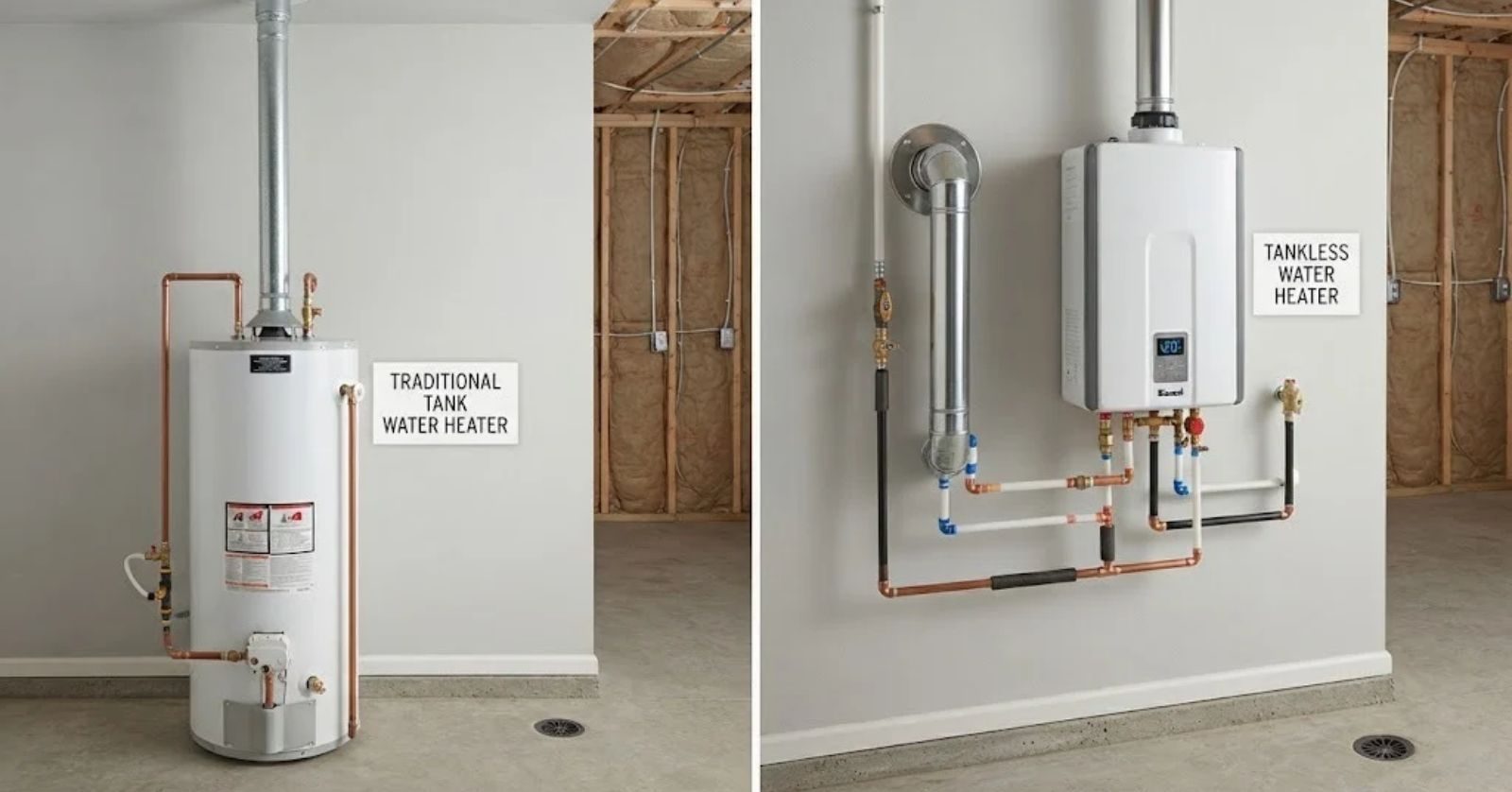
A tank water heater keeps a set volume of water, usually 40 to 50 gallons for a typical household, heated and ready at all times. A tankless unit heats water on demand as it flows through, with no standing reserve, which is why it's often marketed as delivering endless hot water.
The Real Tradeoffs
Tank units cost less upfront and install more simply, often as a straightforward swap into the same space and connections as the old one. Tankless units cost more upfront and frequently require a larger gas line and new venting, but they take up less space and can outlast a tank unit with proper maintenance.
Why Pflugerville's Water Matters Here
Hard water affects both types, but it hits tankless units harder per gallon because the water moves through a narrow heat exchanger at higher velocity. Without a softener or a yearly descaling service, a tankless unit's output can noticeably decline within a couple of years in an area with water this hard. That's not a reason to avoid tankless, just a real maintenance commitment to plan for.
Space and Installation Considerations
A tank unit needs a dedicated closet or utility space sized for a 40- to 50-gallon cylinder, while a tankless unit mounts on a wall and takes up a fraction of the footprint. For a garage or utility closet that's tight on space, that difference alone sometimes settles the decision regardless of the other tradeoffs.
Making the Actual Decision
A larger household with multiple bathrooms in regular simultaneous use tends to see the clearest benefit from tankless. Running out of hot water mid-shower is the exact problem it solves. A smaller household or a straightforward like-for-like replacement often does just as well with a tank, at a lower upfront cost and simpler installation. Neither is the objectively better choice, it depends on how your household actually uses hot water.
Fuel Type Matters Too
Both tank and tankless units come in gas and electric versions. The choice interacts with the tank-versus-tankless decision. Gas tankless units generally deliver higher flow rates than electric tankless, which matters more for larger households, while electric tank units are often simpler to install where gas service isn't already present.
What Happens to the Old Unit
Whichever direction you go, removal and disposal of the old water heater is part of the replacement process, and we handle that as part of the installation rather than leaving it as a separate task for you to arrange.
Recovery Time and Peak Demand
Recovery time, how quickly a unit can produce more hot water once its current supply is used, is where tank and tankless differ most in daily practice. A tank has a finite reserve that takes time to reheat once depleted, while tankless has no reserve to deplete in the first place, it heats continuously as long as demand doesn't exceed its maximum flow rate. For a household that regularly runs multiple showers back to back, this difference is the most tangible day-to-day distinction between the two.
Warranty Differences Worth Knowing
Tankless units often carry longer manufacturer warranties than comparable tank units, sometimes extending well beyond a decade on the heat exchanger specifically, though maintaining that warranty typically requires documented regular descaling, especially in a hard water market like Pflugerville. It's worth reviewing the specific warranty terms before deciding, since skipping maintenance can affect coverage down the line.
Side-by-Side Comparison
Tank Water Heater
- Lower upfront cost.
- Simple like-for-like installation.
- Limited hot water supply at peak demand.
- 8-12 year typical lifespan.
Tankless Water Heater
- Higher upfront cost, especially with gas line/venting work.
- Endless hot water on demand.
- Smaller footprint.
- Longer lifespan with regular descaling.
For a straightforward tank replacement, our water heater installation and replacement page covers sizing and what to expect. If tankless is the direction you're leaning, our tankless water heater service page goes into the gas line and descaling considerations in more detail. We install both types for North Austin households.
Common Questions
Is tankless worth it for a small household?
Often not as clearly, since the main benefit, not running out of hot water at peak demand, matters most for larger households or homes with multiple bathrooms in simultaneous use.
Can I convert from tank to tankless without major work?
Sometimes, but plan on at least checking the gas line size and venting requirements, since most tank-to-tankless conversions need at least some adjustment there.
Which option handles Pflugerville's hard water better long-term?
Neither handles it better on its own; a water softener installed ahead of either type meaningfully extends its life.
How much more does a tankless unit typically cost upfront?
It varies by household size and whether gas line or venting work is needed, but tankless installation is generally a larger upfront investment than a straightforward tank swap.
Do tankless units need any regular maintenance beyond descaling?
Descaling is the main recurring task; beyond that, periodic visual inspection of venting and connections is a reasonable habit.
Is electric or gas better for a tankless unit?
Gas tankless units generally support higher flow rates for larger households; electric tankless can be a good fit for smaller households or where gas service isn't available.
How long does a typical installation take?
A straightforward tank-to-tank swap is usually a few hours; a tankless conversion with new gas line or venting work can take a full day.
Does skipping descaling actually void a tankless warranty?
Many manufacturers do require documented maintenance to keep the full warranty valid, which is worth checking on your specific unit's terms before deciding to skip a service.
How much space does a tankless unit actually need on the wall?
Most residential units are roughly the size of a small suitcase mounted flat against the wall, considerably smaller than the footprint of a standard tank.
Can a tankless unit serve more than one bathroom at once?
Yes, properly sized units can supply multiple fixtures simultaneously; sizing to your household's actual peak demand is what determines how many fixtures it can handle at once.
Does a tank unit need a drain pan?
In many installations, yes, particularly when the unit is located above living space, as a safeguard against water damage if the tank ever fails.
Is a hybrid heat pump water heater a third option worth considering?
It's a real alternative for some households, generally more energy-efficient than a standard electric tank, though it has its own space and installation considerations separate from the tank-versus-tankless comparison.
Does household size alone determine which option is better?
It's the biggest factor, but peak usage patterns, like multiple showers running at the same time each morning, matter just as much as raw household size when deciding.
Can I keep my existing water heater location for either option?
A tank swap typically keeps the same location; a tankless conversion sometimes relocates the unit to a wall-mounted spot closer to where venting can be run efficiently.
Ready to Compare Options for Your Home?
Call for a free assessment, no pressure either direction.
Call (512) 737-6168